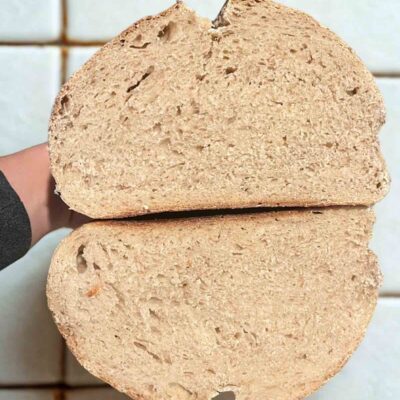
Soft Sourdough Rye Bread
This sourdough bread recipe has the benefits of fermentation without the addition of whole wheat flour. Combining bread flour and all purpose flour, this loaf will convert anyone to eat sourdough bread!
Equipment
- 2 Mixing Bowls
- 2 Tea towels
- 1 Sheet Pan
- 1 Thermometer
- 1 Dough Cutter
- 1 Razor
Ingredients
- 5.4 ounces Bread Flour
- 5 ounces Dark Rye Flour
- 23.4 ounces All Purpose Flour
- 19 ounces Water
- 7 ounces Sourdough Starter
- 0.8 ounces Salt Kosher, Sea Salt or Himalayan Sea Salt
Instructions
- This recipe is not fussy. You can stretch and fold the dough as many times as you want and no specific time needs to exist between them. You can also use unfed sourdough discard or active sourdough starter and will experience similar results.
- Combine the three flours (all purpose, bread and dark rye) together in a large bowl. Add water and stir by hand. The mixture will seem dry and will form a shaggy ball. Do not be tempted to add more water at this time as sourdough starter will be incorporated in the next step. Allow to sit for 20-30 minutes before adding the additional ingredients.
- After autolayse is complete, add the salt and sourdough starter to the large mixing bowl. Incorporate the ingredients together, kneading by hand until the salt granules are no longer noticeable. This should take about 5-7 minutes. The dough will feel quite stiff at this point and will form a ball in the bowl.Cover with a lid, damp tea towel or plastic bag. Allow the dough to rest for 20-30 minutes.
- After this time has passed, stretch and fold the dough until it is hard to stretch without the dough seeming to breakAfter each fold, turn the bowl counterclockwise. This should take about 15-20 stretch and folds. The dough will be stiff and hard to stretch by the end of these stretch and folds as the gluten begins to form. You can stop here with stretch and folds or complete another set of 15-20 in 30 minutes if you wish.
- Once done with stretch and folds, cover, and allow the dough to sit at room temperature until it has doubled in size. This can take anywhere from 6 to 14 hours depending on the temperature of your home and if your sourdough starter was active discard at room temperature or discard from the fridge.
- After the bulk fermentation is complete, the dough will have large bubbles on the surface, the top of the dough will no longer be sticky when touched and the dough will jiggle when the bowl is moved.
- Remove from the bowl and split the loaf into two. Grab another bowl and two tea towels. Use the pastry cutter to divide the bread into two separate loaves.
- Place one tea towel in each bowl. Allow the dough to sit on the on the counter for 20 minutes to 'rest' before shaping.
- Shape the dough by making a rectangle before folding the corners in like an envelope (think "head, shoulders, knees and toes" aka - top first, sides on top, sides on bottom, bottom up). Seal the ends by pinching them together and begin to create surface tension on the dough.
- To create surface tension on the dough, use one hand to pull the dough slowly towards you, and the other to turn the bread. Continue to pull the dough towards you a number of times to create a smooth exterior on the dough.
- Place seam side down in the bowl and wrap the tea towel around the bread. If you have a lid, place this over the bowl or cover with plastic wrap or a plastic bag. This will ensure the top of the bread does not dry out in the fridge.
- Allow the bread to rest within the fridge for 12-24 hours. When ready to cook, preheat the oven to 425 degrees Fahrenheit. When ready to bake, remove from the fridge and place the loaves on a lined sheet pan. Score each loaf with one slit down the middle, or score however you prefer.
- Bake the loaf in the oven for 35-40 minutes. The bread will be done when it reaches 185-190 degrees Fahrenheit. It is important to check the temperature of the bread because the exterior will seem crunchy / firm to the touch but the inside will be undercooked around 25-30 minutes.
- Remove from the oven and allow to cool on a wire rack before slicing.
Notes
Autolayse:
The most important part of this recipe is calculating for the time of autolayse. We like to ensure our water and flour have 20-30 minutes before adding other ingredients. We find the bread dough is smoother and stays moist longer since the flour has had the chance to soak up some liquid prior to adding the additional ingredients. Sourdough - Starter vs. Discard:
This recipe works well with sourdough starter discard or active starter - with little to no impact on final rise and texture / taste. The difference will come in play during the bulk fermentation period. If sourdough discard was in the fridge, it will be cold and take longer to ferment. If it is active starter kept on the counter, it will rise quicker.
The most important part of this recipe is calculating for the time of autolayse. We like to ensure our water and flour have 20-30 minutes before adding other ingredients. We find the bread dough is smoother and stays moist longer since the flour has had the chance to soak up some liquid prior to adding the additional ingredients. Sourdough - Starter vs. Discard:
This recipe works well with sourdough starter discard or active starter - with little to no impact on final rise and texture / taste. The difference will come in play during the bulk fermentation period. If sourdough discard was in the fridge, it will be cold and take longer to ferment. If it is active starter kept on the counter, it will rise quicker.
Nutrition
Serving: 1sliceCalories: 164kcalCarbohydrates: 34.1gProtein: 5.1gFat: 0.6gSaturated Fat: 0.1gPolyunsaturated Fat: 0.1gMonounsaturated Fat: 0.1gSodium: 370mgPotassium: 77mgFiber: 2gSugar: 0.2gCalcium: 9mgIron: 1.8mg
Tried this recipe?Let us know how it was!